Showing posts with label Revision. Show all posts

Saturday, July 4, 2015

Book review: The Writer's Digest Writing Clinic: Expert Help for Improving Your Work

(Affiliate links)


If you’re a writer, you’re a reviser, and if you’re like me, the revising is the hard part. I can produce rollicking piles of crappy writing in no time flat, but it’s a hard, laborious process to turn it into something anyone would want to read. And since I’ve spent half my life revising academic papers, at times it takes a concerted switch in mindset to edit my fiction. 


One of the best tools I’ve found for this is The Writer’s Digest Writing Clinic: Expert Help for Improving Your Work, by Kelly Nickell. The bad news up-front is this book is out of print; the good news is you can get ‘used’ new copies without too much problem. I originally found this book at my library and loved it so much I bought a copy for myself.


The contents


The book has divisions for fiction, non-fiction, and poetry, and then moves on to helping you get your writing published with divisions on writing queries, synopses, and proposals. Each division has sections that deal with a topic: opening hook, point of view, narrative voice, dialogue, exposition, etc. At the beginning and the end of the book there are sections to help you find writing groups, and to help you navigate critique groups effectively to get what you need and leave the not-so-great parts behind. 


The approach


For each topic, the book has an introductory explanation of the basic issues involved, and then takes a piece of writing and edits it right in front of you—all the marks an editor would make, along with annotations that explain why the changes were made. 


Then, at the end of each topic, there is a ‘your turn’ section that walks you through checking for this issue in your own writing. For example, '(1) Take a look at your first three scenes. Write ‘PI’ next to the points where your main character’s personal intentions become clear. Do the intentions propel the scenes forward and add insight into your character? Are they consistent with your intended storyline? (2) Now chart your character’s journey. Write ‘j’ next to thoughts and actions that are inspired by your character’s personal intentions. Is your character’s journey apparent in each scene? Do the marked points move the scenes forward?

At at the end of each division (fiction, non-fiction, poetry, etc.) is a general editing checklist for quick reference. 


My take-away


I’m a very show-me sort of person; telling me that too much description is slowing the pace of my scene is one thing, but showing me before-and-after examples makes it far more real for me. And when you’ve got annotations along with those changes, well, now we’re talking. Something about getting a look at something through an editor’s eyes helps the information penetrate my thick skull more effectively.  

I think this is an excellent book whether you're new to revising your own stuff or you've been doing it for a long time--I periodically flip through it to refresh my memory. 

If you're looking for other good books to help you with revision, check out my review of Rock Your Revisions by Cathy Yardley here
Happy revising!
M.

Sunday, June 28, 2015

Let's talk about rejection, baby


(Affiliate links)


So this happened:


I recently wrote a flash fiction piece I was pretty darn happy with, and submitted it to several publications. I got two responses back. The first said my story had been rejected because my protagonist’s mental state and behaviors were completely unrealistic, that nobody would ever react the way my protagonist had reacted. The second also rejected the piece because they weren’t accepting fiction pieces, but said that my story felt very true to life, and was highly relatable.  


Confused? Understandable. But don’t be. 


This anecdote illustrates two important truths I’ve learned about rejection: much of the time it has nothing to do with you or your piece, and most of the time it’s based on highly subjective opinions. 


A reader’s reaction to a piece is subjective. The first rejection felt my piece was unrealistic. The second felt it was relatable and true to life. Who was right? They both were. For the first reader, the piece didn’t work. For the second reader, it did. We’ve all read stories that we loved and our dear friend hated, or vice versa. There are different styles and tastes out there, and that’s wonderful! So why, when we get a rejection, does our mind tell us that our piece must be bad, rather than just not right for that particular publication? 


Which brings me to that second truth: so much of this is about fit and timing. Even if a publication loves your piece, it may not be the right fit for them for other reasons. Maybe they’ve just published five pieces about mindfulness meditation; if so, yours could be a masterpiece of perfection, but that ship has sailed. Maybe they’ve met their quota of short stories and only have room for flash pieces this month. Maybe the reader has been throwing up after eating the wrong street meat and didn’t have the capacity to appreciate your masterfully realistic descriptions of the thanksgiving dinner preparations in your story. You just never know. 


I like to think about it this way. When you go into a restaurant, you have room for one meal. You look at the menu, and  you pick something, then you eat it. That doesn’t mean everything else on the menu was unacceptably bad and the chefs that prepared those dishes should go out back and shoot themselves. It just means at that moment in time, chicken parm was what you wanted. Same thing with publications. They can’t publish everything, so they have to take what works best for them at that moment. That doesn’t necessarily mean the pieces they turn down are worthless. 


Absolutely no piece of writing, no matter how perfect and amazing, can possibly be a good match for every publication out there. I think that bears paraphrasing: the most exceptional piece of writing created on this earth will get rejected somewhere. Lots of somewheres, in fact.


Of course, this doesn’t mean you should just ignore the feedback you get. In the time between the first and second response above, I took a careful look at my character’s motivations and choices. I looked at my reasons for writing the story the way I did (I have expertise related to the theme of that piece), and I decided I believed in the story as it was. In other cases, I’ve made changes based on feedback I’ve received. In fact, if your piece has been rejected numerous times, you should get a new pair of eyes to look it over and be open to making changes. How do you know when to take that advice and when to leave it? Well, that’s a blog post for another time (although you can find a really good discussion of this in Jordan Rosenfeld’s book A Writer’s Guide To Persistence, see my full review here). For now I’ll just say that I try to be honest with myself and listen for advice that strikes a chord in me. If nothing sounds right after I’ve considered it with an open mind, I will choose to keep my original vision. Never make a change just because someone suggests it, always stay true to your vision for the piece. 


But what it does mean is you should never tell yourself that rejection = failure, and you should never quit. The great Wayne Gretsky once said this: 100% of shots not taken don’t go in. To put it another way, if you don’t submit the piece, you’re guaranteed it won’t get accepted. The odds are better the moment you submit; the probability of acceptance can only go up. And no hockey player expects every shot they take to go in the net; they know plenty are gonna miss and they’re gonna have to keep taking more shots. Writing is no different. 


One member of our writing group (thank you, Julia) reminds us often that rejection is a sign you’re putting yourself out there, that you’re being a writer! So many people never work up the courage to do that, and instead let their fear of rejection stop them from trying to achieve their dreams. If you're getting rejected, it's because you're overcoming those fears.


So submit. Get rejected. Revise the piece if you think it will help. Submit again. And wear that rejection as a badge of honor that only the working writer can claim. 


Oh, by the way. That piece that got those conflicting rejections? It was accepted the next time I submitted it. And in the meantime it taught me a lesson I'll hold near to my heart through a lot of future rejections.


Keep submitting, my friends.
M.

Sunday, May 24, 2015

Review: Rock Your Revisions by Cathy Yardley

(Contains affiliate links)

In my recent post about my revision process (you can find it here if you missed it), I mentioned that there were several books that helped me along my fiction revision path (which turned out to be very different from revising my previous non-fiction). I’m going to do a series of reviews on the ones I like, starting with one of my very favorites, Rock Your Revisions: A Simple System for Revising Your Novel, by Cathy Yardley. 


Rock Your Revisions has been a life-saver for me; it helped me stake out an effective approach to my revisions, and then walked me through each portion of them. I’ve come to think of it as a user’s manual for fixing your novel, like the kind of user manual that walks you through repairs to your car. 


Maybe it’s only me, but a manuscript can be intimidating, sitting there all bulky with lots of pages and chapters and paragraphs and sentences—where do you even begin? Page by page, looking for every possible issue as you go? How would that even work? How do you keep track of everything you should be checking for? And what if all you can figure out is that a scene or section isn’t quite working, but you’re not sure how? 


This book helps with all of those issues.


Built into the structure of the book itself is a plan for tackling your revisions and breaking down the nightmarish big-picture into manageable chunks. Because you can’t keep track of everything at once, so don’t even try—instead, do it in stages. The book takes you through a three-pass process of revising your novel one step at a time, and as it walks you through, it helps you diagnose problems you might not be able to recognize. 


The first revision pass takes you through structural revision; this looks at the between-scenes structure of your book, or Yardley refers to as ‘framing your house’. Here you’re going to look at your story structure, your characters and your storytelling devices. Within this section, the book continues to walk you through step-by-step to help break down this revision pass(of course you don’t have to follow it if you don’t want to):  


Pass 1: Structural revision pass
Quick read
Scene Chart
Characters (Story-level)
Plot Points and Story Arc
Characters (scene-level)
Scene flow and escalating conflict
Talking head avoidance devices
Opening Scene
Closing Scene
Creating the first pass plan


The second pass is the scene revision pass; as Yardley puts it, in this section, you’re going to make sure every room in your house has a purpose and is furnished in a manner that serves that purpose. Here you’re going to make sure that each scene is structured well as its own unit (has a goal that you’ve acieved), that everything flows, and that the contents are compelling to your reader (you don’t bore them with too much narrative summary, etc.):


Pass 2: Scene revision pass
Anchoring/setting
POV revisited
Dialogue check
Exposition
Detail


Finally, the third pass is your fine polish pass, where you decorate your rooms, make ‘em nice and pretty for your visitors. Here is where you do the equivalent of line-editing. This pass is represented by a single chapter in the book, broken down into different issues like checking for repetition, checking for typos, and the like. Yardley assumes that you mostly know the drill here—after all, you’ve been doing this sort of revising most of your life--but gives a good reference for more help in this area: Self-Editing for Fiction Writers by Renni Browne and Dave King (which I will be reviewing next time, because I love that book, too). 


In each sub-section throughout the book, Yardley defines the important concepts you need to know, shows you what you’re looking for via examples, and gives you ‘assignments’ at the end to allow you to put the advice into action. Her explanation and examples are clear; some advice books I’ve read will give you 2-3 pages of a book or story to read to illustrate a point, and by the time you read it, you forget what you were looking for. Her examples are concise and user-friendly. 


Most of all, I love this book because it has a flow-chart nature to it; overall, as I’ve already mentioned, but even when it comes to individual issues. For example, in one sub-section about making sure your characters are behaving consistently, she gives a diagnostic tool to apply for each scene in turn (I have paraphrased this somewhat for space reasons; she explains as she goes): 


(1) Identify the POV character in a scene.
(2) Identify the scene’s goal
(3) Check this goal against the overarching Goal-Motivation-Conflict of the POV character.
(4) If there is a mis-match (if the scene’s goal conflicts with the GMC), adjust your scene. 


For me, this syllogistic trouble-shooting approach is perfect. Sure, somethings I can figure out for myself. But sometimes I may know I need X, but I have no idea how to get X. This helps break it down in a way that clicks with my mind. It makes things crystal clear for me, and gives me an action-oriented way to diagnose what's wrong with the scene, and how to solve the problem. 


In my writing life, I have taken the essential approach of Rock Your Revisions and modified it suit my own style. I don’t follow the exact order she suggests, and I have a few other things thrown in that I know I personally need to address when I revise. But this was the book that helped me begin carving out my approach to revision, and I still go back to it when I revise. I think it’s a great place to start if you’re facing your first revision, and an excellent way for more experienced writers to help smooth over their problem areas.     


Do you have any books or other sources you've found helpful for revision? I'd love to hear about them in the comments if so!


Happy revising,
M. 

Saturday, May 2, 2015

Now what?!: How I revise my manuscripts

(Affiliate links)

Yes, I did it!!
So you wrote a novel during NaNoWriMo or CampNaNoWriMo or whenever, and now you need to revise it. Confused? Overwhelmed? Unsure where to start? 


Yeah, I know how you feel. Revision still strikes fear in my heart, but I’ve revised a few novels now, and I’ve learned a few things that might help you out. Here’s how I revise, with a few tips along the way. 


My first draft

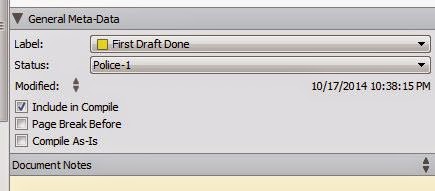
I'm the sort of writer who needs a lot of revision, because I write my first drafts most effectively when I lock my internal editor in the trunk at the back of my closet, trussed and gagged. Once she’s dealt with, I usually start with an idea, and build in my structure as I go (you can see an explanation of my pl-antsing approach here); I don’t write in a linear fashion. When I realize I’m going to need a scene or a set of scenes, I create pages in Scrivener as a placeholder for them; I give all my scenes names/descriptions and assign them Scrivener ‘labels’ to indicate which scenes are finished and which are still in progress. As I finish the draft, I check my labels to make sure I’ve gone back and written all the scenes I was supposed to write.


I change my label when I finish the scene...
In corkboard view, the color of the pins quickly tells me which scenes are done (yellow). 


Then, I set the manuscript aside for six weeks; nary an eyeball nor a fingertip shall molest it during that time.


First revision pass

My first pass consists of three parts: read-through, prep, and revision.


Read-through: The first thing I do is read through the manuscript as though it were any other book. I print it out with font, spacing and formatting that gets it as close to a printed paperback as I can get it, grab myself a cup of coffee, and read. I keep a pencil at my side, but not in my hand because I don’t let myself edit; I only make broad notes at this point. I’ll mark where the pacing it too slow or too fast, where I need more introduction, where I need to mention some crucial point earlier in the plot; I’ll note where characters are coming across flat or inconsistent, when I need additional scenes, or when I need to move scenes or cut them completely.


Speaking of, there's an excellent tip I’ve seen several places, including K.M. Weiland's podcast: know what your weaknesses as a writer are, and focus on them during revision. One of mine is too much narrative summary, and this is where I call myself on that tendency; you’ll find ‘NS’ generously decorating the pages of my first read-through everywhere I find summary that needs to be developed into an action scene. If you don’t know yet what your weaknesses as a writer are, keep your eye open as you do your first read-through, and/or ask your beta readers if they can identify any when they read your manuscript. This will helping you knock out some problems quickly the next time around.


Prep: Now I pull up my manuscript in Scrivener, and create an associated spreadsheet in excel. For each scene I’ve written, I create a row in the spreadsheet with columns for the name, description, and revision goals. I consult the notes I made during my read-through, and add any new scenes I decided I needed, both into Scrivener and into the spreadsheet. I will use this to track each of the changes I need to make, and to track my future revision passes:


For each of these in Scrivener...


I create a row in my spreadsheet.


Revision: Now I'm ready to go through and make all of the changes I noted during my read-through; I do this in order, so I can keep track of information flow and pacing as much as possible as I go.


Second revision pass

This pass consists of three parts: read-through, pacing, and revision


I do another read-through at this point to verify that the changes I made in my first revision pass did what I hoped they would do, and that my basic structure and storytelling is sound. I make notes as needed; hopefully there are far fewer of them this time.  


Now that I'm pretty sure I have my basics organized, I check my pacing. I check my overall pacing in my spreadsheet; I note where I have action, backstory, climax and resolution scenes, and rate them on a 0-9 scale for tension:


I track the individual story arcs for any sub-plots directly in Scrivener. This was particularly important for my first book, Hazel-Green, a family saga; each generation had its own story arc in addition to the over-riding arc for the book. Scrivener allows me to pull out all scenes that have a given character (or anything else you want to select for), so this is easier to track and work on directly in the program.

If I feel my pacing is off anywhere, I will tinker with my order or add/remove what I need. Once I’m satisfied with that, it’s time for more revision; this time I’ll revise for several specific problem areas. I generally do this mostly scene by scene, and track what I’ve done in my spreadsheet (see above). I go through and make sure my characters are consistent and distinct. I do a setting check, to make sure I’ve adequately set the scene as needed (place, time, and any other relevant aspect). I check my dialogue to make sure it reads authentically.


Why use a spreadsheet for this? When I'm checking my characters, for example, I go through and work on one character at a time; this means I'm not working in a strictly linear manner. The spreadsheet lets me mark off each scene as it's finished for each character, etc., so I know where I need to go back and do what.


Third revision pass

At this point, I polish the writing itself; here’s where I go through and do my line-editing, tighten the writing, and make it as beautiful and compelling as I can. Why not before? I find it's much easier to cut a scene when I need to if I haven't spend days and days polishing it to perfection, so I leave this part for when I'm fairly certain what I'm polishing is going to stay in the book. In my spreadsheet, I highlight the name of each scene in one of five shades of purple, dark for scenes I think are well-written, light for those that need lots of work, with shades in between as needed. I keep working until all the scenes are the darkest shade.


Also at this point I print out a calendar for the time period covered by my book, and track out the exact timing of everything that happens. This lets me make sure I haven't made any stupid errors that will undermine my plot (like having a full-term baby appear only four months after the couple consummates). 


Final pre-beta revision polish 

Why do I need another polish if I’m happy with all my scenes? Because I can’t trust my own eyes, that’s why. This pass is for silly little things I know I shouldn’t do, but still manage to miss, like passive voice, weak verbs (‘walk’, ‘go’) annoying constructions like ‘started to’ and ‘began to’, and unneeded adverbs. I compile my manuscript so it’s all in one document, and use the search function to pull up all instances of these trouble makers, then I fix them directly in Scrivener. 


Last but most certainly not least, I read my entire manuscript out loud to myself to catch typos and anything else that doesn’t read right. In one of K.M. Weiland’s podcasts, she mentions that if you have a kindle, you can also have it read your manuscript to you; Scrivener can compile into a .mobi file for you, so I’m definitely going to try this with my current work-in-progress.


Off to beta readers!

This is where I’ll send the manuscript off to beta readers. I’ll certainly need to revise more, but at this point I'll need their help to show me the way. So for now, my revision is done, and I can go and do my double-chocolate happy dance!


So there you have it. I hope some of this has been helpful for you. Stay tuned, in the next few weeks I hope to review a few of my favorite revision advice books. In the meantime, if you have any revision tips, I'd love to hear about them!

Happy revising, 

M.